

Training that moves people.
One learning service your companies share. Embed it in your app or send people to your own portal. One login for every course a person holds.
Your tools, inside the lesson
A simple training platform whose lessons can open your own app’s tools, live.
Most training tools show a screenshot of your product, a recording of it, or send a learner off to a separate course site that looks nothing like the app it is training people to use. Rocket & Rudder is built to be a simple training platform: write the lesson, publish it, and a person is training in minutes. When a step needs more than words and pictures, it can open one of your own app’s real screens instead of a copy of one, so the practice is the actual tool a person will use on the job.
How it works: the host embeds the SDK, a lesson step can mount one of the host’s own surfaces, and progress is recorded either way.
Your app, as your people use it every day.
Visitbook is an invented example: a small scheduling app with its own clients screen.
Live data
Clients
- Maya ChenTue 9:30
- Oliver GrantWed 14:00
- Priya NairFri 11:15
Visitbook is an invented example app. In your own app, the lesson opens your app’s real screen, either mounted in place or through your app’s training-mode route, on the record the lesson names, and your app reports which checks pass. The training copy each learner starts from is set up in your app, by your app.
One login, many portals
A person signs in once and sees every course they hold.
A course tool that asks for a new password per course is a tool people stop opening. Here the person is the account and each company is a portal hanging off it. Switching portals never asks for a password, and each portal keeps its own enrollments, its own name and its own address.
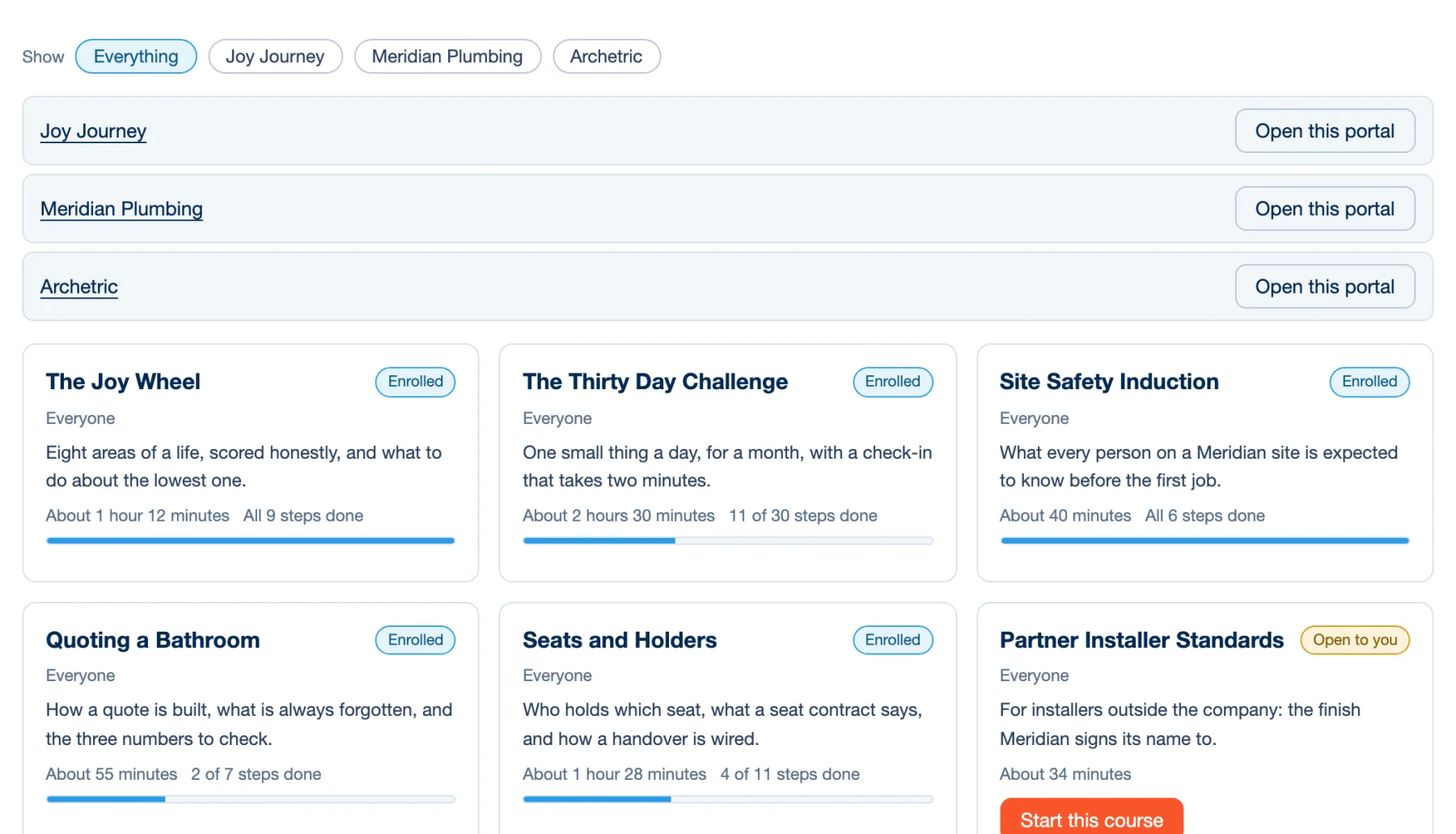
All my courses, on the service’s own front end. Filter by the portal a course came through, or open that portal and stay in it.
Author with help
Write the course, and let the model do the typing you would rather not.
Upload the handbook and the SOPs your company already has, say what you want built, and read what comes back. Questions are drafted from the lesson’s own text, and any question whose answer does not reuse the lesson’s words is thrown away before you see it. Nothing is published until a person publishes it.
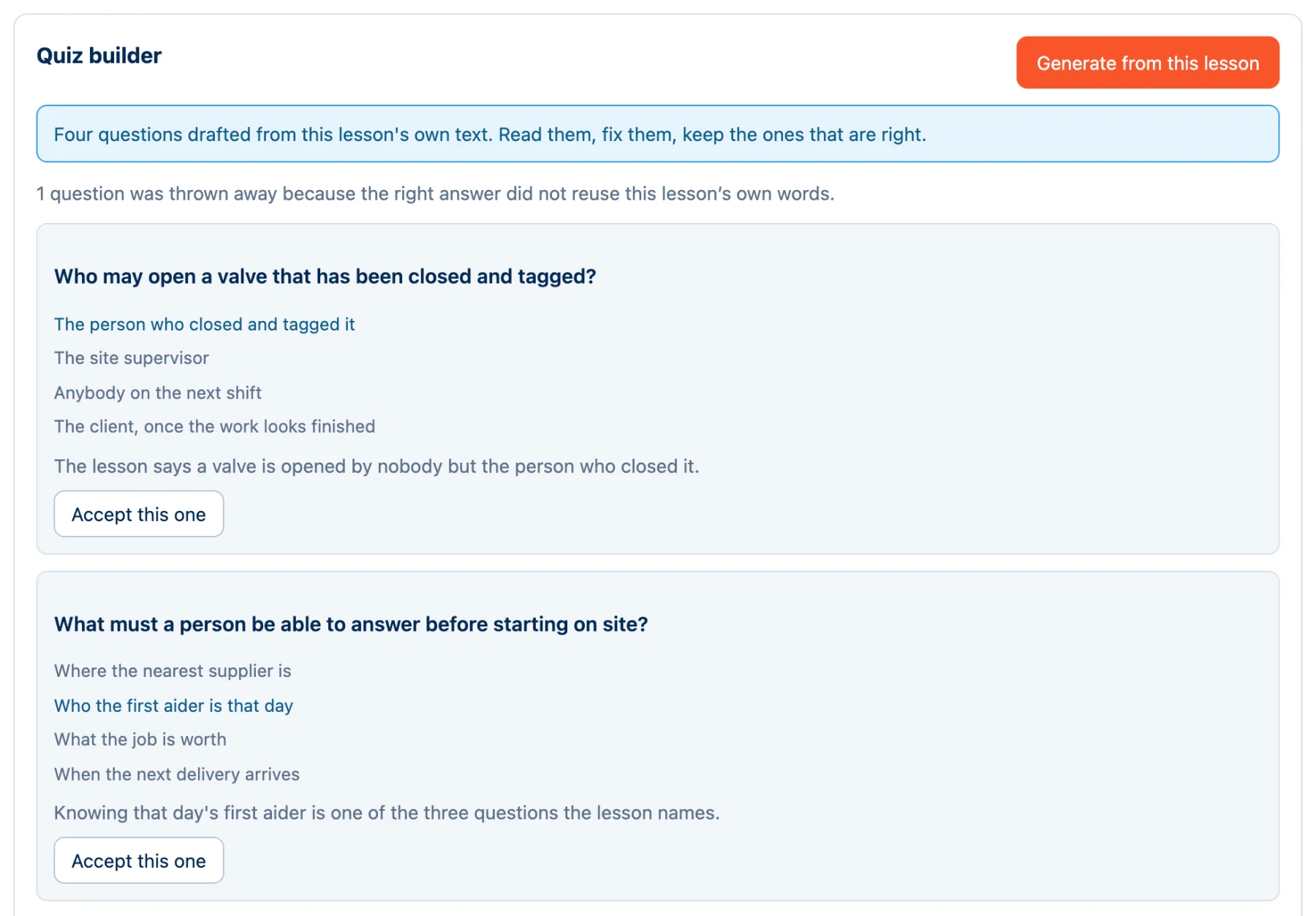
Four questions drafted from one lesson, one thrown away by the grounding check, and an author who accepts, edits or deletes each one.
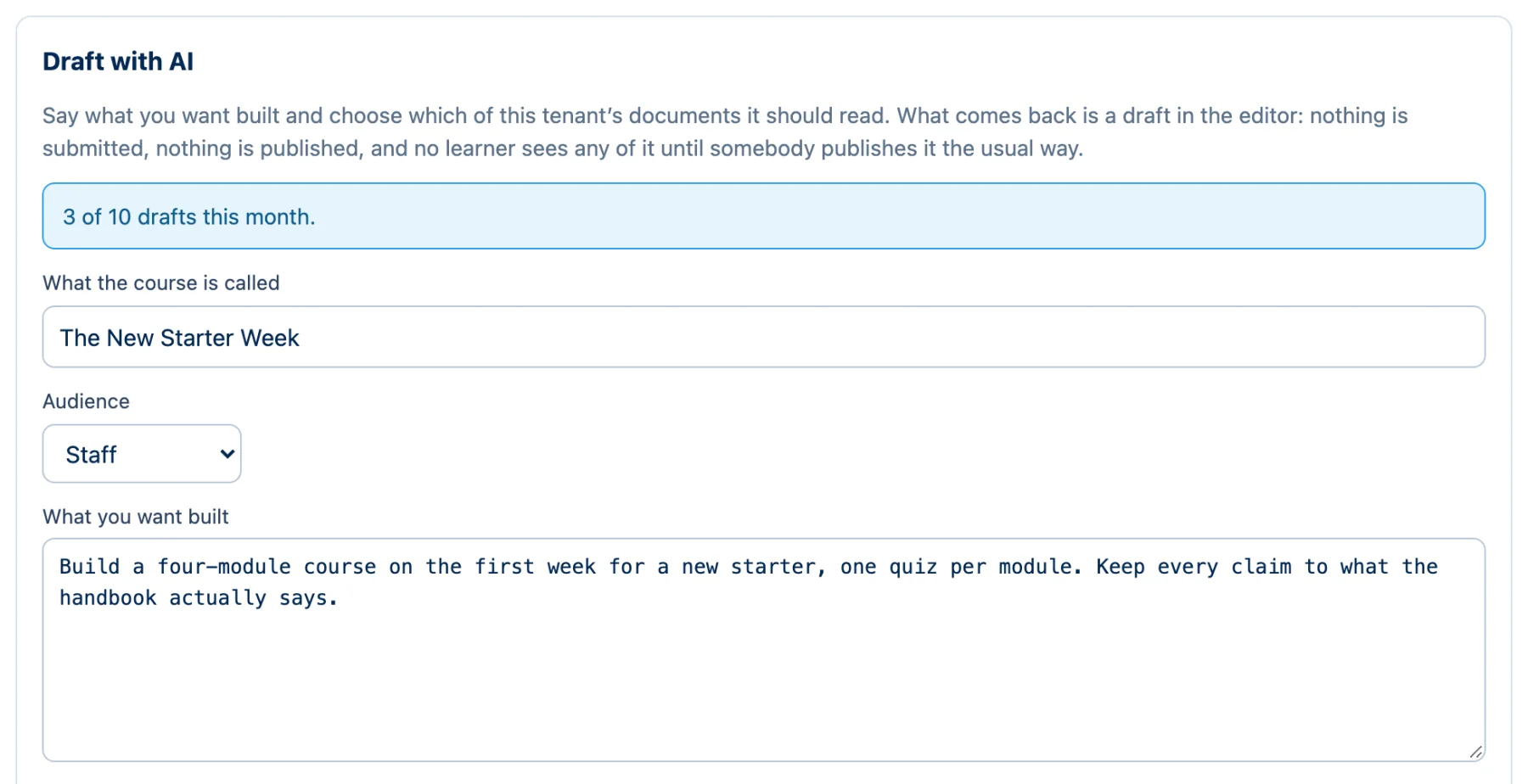
Your documents stay inside your company. Nothing is trained on them, and the month’s included drafts are counted on the panel rather than on a bill.
Tell it what to do
Say it in a sentence. Read what it will do. Then say yes.
Type grant Bob Smith the onboarding course for free and the operator shows a card naming the learner, the course, the company, the price and the expiry. Nothing happens until somebody confirms it. Two people called Bob Smith produce a list, never a guess, and every instruction is recorded with who said yes.
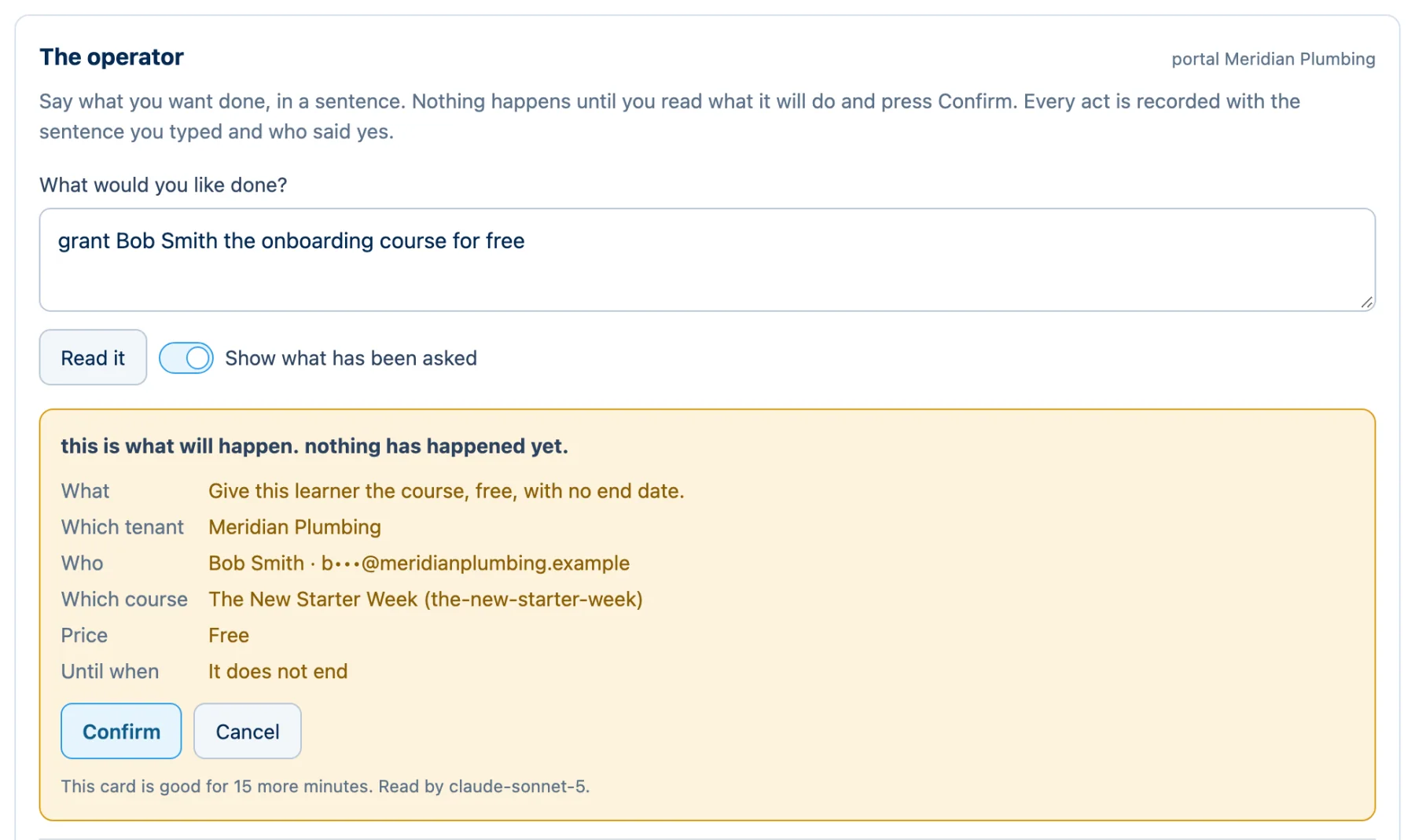
The card the operator draws before anything is written. It expires in fifteen minutes if nobody acts on it.
See where people get stuck
The numbers are counted, not guessed, and they are there before you ask.
Which lesson people open and do not finish. Which question they get wrong, and which wrong option they pick. Which check on a real screen nobody passes. Every figure is computed from the rows the service already writes, per course, so it is on the screen whether or not you ever ask a model what it means.
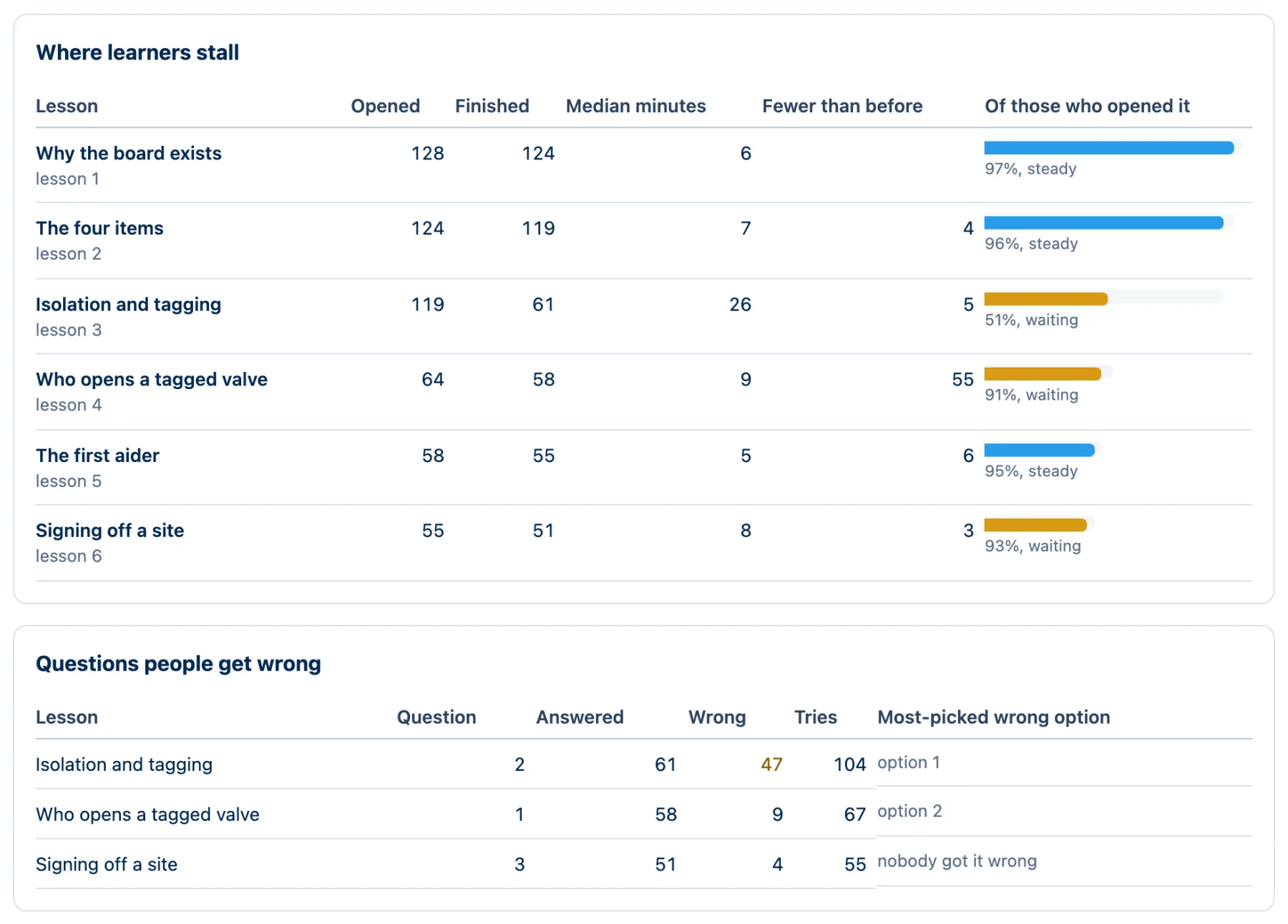
Lesson 3 is opened by 119 people and finished by 61, at 26 minutes against a course median of 7. That is a lesson to split, and the screen says so before anybody asks.
Who it is for
Three ways in, and the same courses underneath all of them.
Companies training staff and partners
Push a course at a group, set a due date, and read who is done and who is late. A partner is a second group, not a second bill.
Apps with their own canvas or tools
A lesson opens the app’s own canvas or tools, live, rather than a picture of one. The practice is the actual screen a person works in, not a description of it.
Any app with a getToken()
If your server can mint a short-lived signed token, your people are already signed in. No second password, and no second set of course rows.
What it costs
Priced by company, never by head count.
$97 a month to 250 active learners, $297 to 2,500, $997 above that. An Archetric business adds training for $47 a month. Every feature is in every band, because a price that hides the editor behind a tier is a price that punishes the customer who is succeeding.